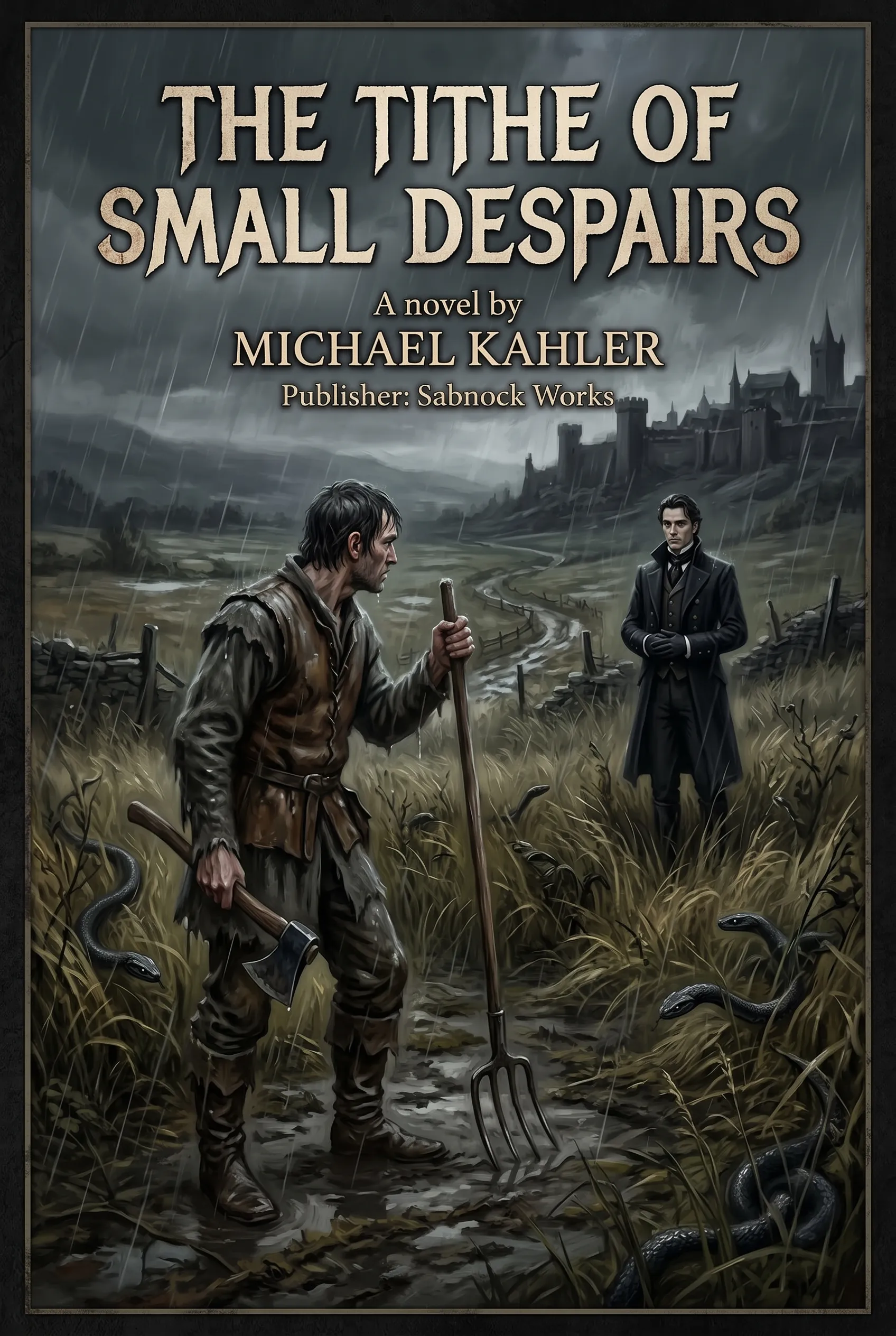
What follows was set down by a man who could not quite bring himself to burn it, and could not quite bring himself to keep it. It was found wedged behind a hearthstone. The handwriting changes partway through, as if the writer's hand had begun to tremble and could not stop.
I. The Weight of the Sky
Despair, he had decided, had a particular quality when it was absolute.
It was not loud. It did not announce itself. It settled over a man the way the low grey sky of the valley settled over the Flats in autumn — without drama, without thunder, without the dignity of a storm. It simply arrived, and then it was simply there, and you understood that it had always been coming and that the only dishonesty had been in not seeing it sooner.
Edric Vane stood in the doorway of his house — the doorway he had cut himself, two months ago, into the back wall, because the curse had taken the front door and he was a practical man — and looked out at his fields. The rain was steady and had been steady for four days. The cabbages were drowning in their furrows. The turnips had gone to rot in three of the eastern beds. And somewhere in the long wet grass between the house and the treeline, invisible and patient as a bad thought, the serpents were waiting.
Behind him, his daughter made a sound.
It was not a cry. Lena was ten years old and had already decided, in the wordless way of serious children, that crying was a form of surrender. It was a breath — quick, controlled, the breath of a person managing something they could not put down. He had heard that breath from her once before, when she had fallen from the apple tree and broken her wrist, and had looked at the angle of the bone and said nothing, only breathed like that, that careful deliberate breath, until he came running.
He did not turn around.
If he turned around, he would see her face, and if he saw her face, the last useful thing in him — the part that was still capable of planning and walking and covering distance — would come apart.
"Maria," he said.
His wife appeared beside him in the doorway. She was a tall woman, rawboned, with hands that had learned patience the same way iron learns it — through long exposure to heat and cold. She looked at the fields. She said nothing for a moment.
"The snakes came again this morning," she said. "Near the well."
He nodded. He had seen the marks. The peculiar pattern of disturbed earth and crushed grass that the serpents left, which was not quite the pattern of any serpent he had known before the curse. These were not the ordinary grass-snakes of the valley floor, the small harmless things that took mice from the grain stores and which he had always regarded with something close to fondness. These were something else. They had come with the curse, or they had been made by the curse, or perhaps they had always been here and the curse had simply removed whatever agreement had previously kept them in the deep grass and the abandoned mine-shafts where they belonged.
They had taken Tobias six weeks ago.
Tobias, who had been fourteen, and who had been walking the eastern perimeter in the rain because Edric had asked him to, because someone needed to check the drainage channels, because the farm required constant maintenance and there were not enough hands. Tobias, who had found a serpent near the largest drainage stone and had been bitten three times before Edric reached him, and who had been dead before sunset.
Edric did not think about Tobias directly. He had discovered, in the weeks since, that thinking about Tobias directly was not something he was yet capable of doing and remaining functional. He thought about him obliquely — the way you look at something very bright by looking slightly to the side of it.
"I'm going to the trading post," he said.
Maria was quiet for a moment. The rain fell steadily. Somewhere in the distance, past the treeline, one of the cursed doors in the valley floor opened briefly onto something underground and then closed again — you could hear it, a sound like a throat being cleared by something enormous — and then the valley returned to its rain-silence.
"She cannot travel," Maria said. "Not the whole way. Not in this."
"I'll go alone. I'll be back before dark." He finally turned. Looked at her face, which cost him something. "The city is half a day too far. The trading post is closer, and Halverson's fort will have an apothecary. They might have a mystic. Even a hedge-witch with the right knowledge — anything with the right knowledge." He paused. "I can't watch another one go, Maria."
He had not meant to say it like that. The words came out stripped of everything except what they were, which was the truth, and the truth in that moment was not dignified and not brave and not the voice of a man who had farmed poor land for fifteen years by sheer refusal to accept that the land had already beaten him.
His wife looked at him for a long time.
"Go," she said. "Come back."
He went.
II. The Road to the Ford
He had thought of the farm's history, on the long walk down, the way a man thinks when he is moving fast and does not want to think about what he has left behind.
His grandfather had received the land as payment for thirty years of service in the city watch — three decades of standing at gates and walking walls and dragging drunks from gutters for the glory of Lathmar, and at the end of it, a deed pressed into his hand with a handshake that had meant now we are done with each other. The land lay in the Flats below the city, in the valley floor where the old river bent, and it was technically fertile — the soil was deep and dark and the drainage was good when it was not terrible — except for the fact that five thousand years of dwarvish mining had buried the original topsoil under a layer of rubble and spoil that took decades of breaking to work into anything useable.
Edric had thought about this, sometimes, in idle moments.
The dwarves had mined those mountains for five thousand years. All that broken stone had to go somewhere. It had gone here, he supposed — down the shafts, out the lower adits, tumbled into the valley by the cartload for five millennia until the original meadow was buried under ten feet of spoil. And then, eventually, men had built the city. With the rubble, presumably. With the waste of all that industrious underground labour, they had built walls and roads and the foundations of towers, and they had handed his grandfather the leftover land and called it a reward.
His grandfather had called it a gift from people who did not like him.
He had called it an opportunity.
His father had called it a burden.
Edric had called it home, and that, he thought now, was perhaps the most honest of all the names, and the saddest.
The road to the ford was empty.
He had expected this, and it still unsettled him. The road to Lathmar's river crossing had always been busy — traders with their gnomish carts, the occasional Ithrax caravan moving their goods (and their other, less voluntary cargo) toward the city markets, farmers with produce and farmers with grievances and farmers with both. The curse had eaten all of that. Trade had collapsed like a bridge with its keystones removed — suddenly, completely, leaving only the memory of the structure and the gap where it had been.
He walked quickly and kept to the road's centre, away from the long grass on either side. He watched the ground in front of his feet and he carried his woodman's hatchet in his right hand and he did not think about Tobias and he did not think about Lena's careful breathing and he did not think about the serpents in the grass, which was itself a way of thinking about all three.
He was a practical man. He moved forward. He arrived.
III. The Fort at the Ford
He smelled the burning before he saw the fort, and the sight confirmed what the smell had suggested: whatever Halverson's trading post had been three months ago, it was not that anymore.
The palisade stood — mostly — but sections of it had been broken inward, the sharpened stakes splintered at their bases as though something heavy had simply walked through them. The gate was open. The guardhouse beyond it was a blackened frame. The smoke that still rose from the ruins was thin and old, the smoke of embers rather than fire, which meant the burning had happened days ago and not hours.
A Skarn challenged him from behind a barricade of overturned carts and salvaged timber.
The Skarn were a people he had always regarded with the cautious neutrality of a man who does business occasionally with someone he does not entirely trust — large, broad, their skin the grey-green of old moss, their voices like stones rolled together. This one was armed with a double-bladed axe that was almost comically large, and was using it primarily as a pointing instrument.
"Post is closed. City's that way. Turn around."
"My daughter is dying," Edric said. "Snake venom. I need medicine."
The conversation that followed was the particular kind of argument that occurs when two men who are both afraid shout at each other across a distance. Edric was afraid for Lena. The Skarn was afraid of something else, something that was inside the post rather than outside it, which Edric noted without yet understanding.
He moved closer by degrees, as though proximity were something he could negotiate while ostensibly negotiating something else.
It was an Ithrax who resolved the impasse, which was not, in Edric's experience, how things usually resolved.
She appeared at the barricade's edge with the particular unhurried quality of a person who has decided that everything has already happened and the remaining events are simply confirmation. She was tall, as Ithrax went — the lizard-folk ranged considerably in their sizes — and her scales had the dull copper colouration of a valley adder, which, given the circumstances, Edric found briefly and inappropriately amusing. Her grin was the grin of a species whose facial architecture did not permit any other expression, but her eyes were calculating in a way that transcended species.
"What is the shouting," she said. It was not a question.
Edric was a practical man. He looked at the ruined fort, at the Skarn's nervous eyes, at the Ithrax's copper scales, and he performed a rapid and unsentimental calculation.
"I have a farm," he said. "Half a day's walk north. Thirty acres of produce, most of it ready to harvest. The curse has not touched it — not the way it's touched the city. Serpents have, but that's a problem I'm proposing you help me solve." He looked at the Ithrax directly, which was not comfortable but was necessary. "I need medicine. An apothecary. A mystic if you have one. In return, I'll feed whatever you have here for two months. Maybe three, if the winter root vegetables hold."
The Ithrax looked at him for a moment with those calculating eyes.
"Someone will accompany you on the return," she said. "To ensure the arrangement is honoured."
"Of course," Edric said.
They both understood that someone accompanying him meant something rather specific, and that both parties were choosing to use the polite language rather than the accurate language, because the accurate language would have required an argument that neither of them had time for.
He went inside.
IV. The Gnome's Price
The trading post's interior had reorganised itself around the new geography of fear. Every door that could be nailed shut had been nailed shut. Every window that faced the right direction — that is, that did not open onto one of the shifting dimensional thresholds the curse produced — had been converted into an entrance, fitted with leather flaps and rope handles and the improvised dignity of people adapting to an absurdity they could not correct.
The few people moving between buildings moved quickly, eyes down, with the practised economy of motion of those who have learned that being briefly visible is preferable to being visible for any length of time.
The Ithrax, he understood now, had not arrived as traders. They had arrived and taken, and what he was negotiating with was the outcome of that taking, and the people who moved with their eyes down were moving that way for reasons that made his stomach close.
He found the apothecary by asking three people in rapid succession, each of whom answered him in the surprised tone of someone not accustomed to being addressed.
The shop was a former storage room, its shelves reorganised with the obsessive precision of a person who controls small things because large things have ceased to be controllable. The gnome behind the counter had the alert, compressed quality of his kind — gnomes always looked, to Edric, like they were managing several urgent thoughts simultaneously and had developed their small bodies specifically to contain the pressure of this activity.
His name was Perwick. He had a ledger open on the counter and he was writing in it when Edric entered, and he did not look up immediately, which Edric interpreted correctly as a negotiating position rather than rudeness.
"Snake venom," Edric said. "My daughter. She was bitten yesterday morning."
Perwick looked up. His eyes were the colour of old amber and they moved over Edric with the speed of someone accustomed to evaluating the financial situations of desperate men.
"Which serpent?" he said. "The new ones or the old ones?"
"New ones."
"Mm." Perwick set down his pen. "The new ones are different. Their venom isn't quite like anything I've catalogued. It works slowly — three, four days before the crisis — which is the only reason your daughter is still alive to be discussed." He turned to his shelves. "I have a compound. It's not a perfect antidote. It will interrupt the venom's progress and give her body time to manage the rest itself, which it can, if she's strong."
"She's strong," Edric said.
"They always are, when their fathers say it." He did not say this unkindly. He set a small clay vial on the counter. "Twenty silver."
Edric looked at the vial.
He had four silver in his purse. He had a farm that was currently collateral for the labour of an Ithrax slaving operation, and he had thirty acres of produce, and he had a daughter who breathed carefully to avoid the indignity of showing pain.
"I don't have twenty silver," he said.
"No," said Perwick. "You don't look like a man who does."
"What I have is a farm. Thirty acres. Ready for harvest." He paused. "I've already committed most of the yield to the Ithrax, in exchange for safe passage back. But I can commit a percentage of the profits beyond that — over the next several harvests. Twenty percent."
Perwick picked up his pen.
"Thirty," he said.
"Twenty-five."
"This is a poor negotiating position you're arguing from," Perwick observed, not without sympathy. "Twenty-eight."
"Twenty-five," Edric said again. "Because twenty-eight means I can't eat through the winter, and a dead farmer produces nothing, and you're a businessman, not a murderer. Twenty-five percent, over three harvests."
Perwick looked at him for a moment longer. Then he wrote something in the ledger and turned it around.
"Sign," he said. "And you should know — given that most of your yield is already spoken for by the Ithrax — that I'll be collecting from them directly. I hope you understand what that means for your arrangement."
"I understand exactly what it means," Edric said, and he picked up the pen. "It means your problem and their problem are now the same problem, and mine is considerably simpler."
Something crossed Perwick's face that might, in a gnome, have been a smile.
He signed.
V. Daughters of the Grass
The Skarn's name was Grould, and he stood a head and a half taller than Edric and carried his double-bladed axe with the casual ease of a man carrying something he thinks about the way other men think about their own hands.
He was not, Edric decided on the walk back, a bad person.
He was a person performing a function he had been assigned, in a system whose morality he had either never examined or had examined and decided was not his problem. This was a distinction Edric had long since learned to make, in a world full of people performing functions in systems. He did not like the function. He had nothing against the person in any way he could articulate to himself.
The six individuals Grould was responsible for were less easy to categorise. They were men and women from four different places, speaking among themselves in two languages Edric did not share, moving with the careful economy of people whose primary concern was the management of their own endurance. They looked at Edric with a wariness he found both understandable and uncomfortable.
They had been walking less than an hour when the first serpent struck.
It came from the grass to the left of the road — not the long grass of the verge but the cropped grass of a field that had been properly managed until recently, which meant it came from nowhere that looked like nowhere, which was worse than coming from somewhere that looked like somewhere. The man at the back of the group went down with a single sharp sound. By the time Edric turned, Grould had the serpent in two pieces with his axe, but the man was already showing the dull flush at the bite site that Edric knew now to recognise.
The second death came forty minutes later. A woman this time, bitten through her boot.
The serpents were everywhere. This was not hyperbole. Edric had spent fifteen years on this land and had developed a working knowledge of where the dangerous things lived and how to avoid them, and none of that knowledge applied anymore. The snakes moved in patterns that suggested coordination, or at least a common will — too many in one place, distributed too evenly across the verge and the field margins, watching the road with the particular stillness of hunters who have learned patience.
He thought: My daughters.
He thought it without understanding why.
After the second death, Grould was nervous in a way that a very large man with a very large axe becomes nervous, which is a specific and troubling kind of nervous because it implies a reassessment of whether the axe is adequate. The remaining four looked at their dead and then at the Skarn and then at Edric.
After the third death — a young man, barely older than Tobias would have been — one of the survivors reached slowly into the grass at the road's edge. He moved with extraordinary deliberateness, the way you move when you have decided that you are already in the worst situation and that the worst situation has a particular leverage you might as well use.
He stood up with a serpent in his fist.
He threw it at Grould.
The Skarn's death was quick, in the way that the deaths of large things are sometimes mercifully quick — a single bite to the side of the neck, above the collar of his armour, where the skin was thin and the blood ran close to the surface. He dropped the axe. He looked surprised, then he looked at nothing in particular, and then he was on the road.
The four remaining looked at Edric.
Edric looked at them.
He was a practical man.
"I didn't buy you," he said. "I'm as much a victim of the Ithrax as you are. The arrangement I made was for labour — paid labour, food and shelter — not for ownership of people." He looked at each of them in turn, which felt important. "You can go. I won't stop you. I can't stop you. I'm a farmer with a hatchet."
Nobody moved for a moment.
Then, with the wordless coordination of people who have learned to make decisions quickly, they began removing the rope from their wrists, and one by one they walked into the field grass and the grey afternoon, and Edric watched them go and felt something that was not quite relief and not quite guilt and was probably the place where those two feelings meet and agree to coexist.
He picked up the axe.
He walked on alone.
The serpents did not bite him.
He noticed this somewhere in the second hour of walking alone through the grass-bordered road, the axe in one hand and his hatchet in the other and the little clay vial in his breast pocket pressed against his sternum like a second heartbeat. The serpents were still there — he could see them in the grass, their stillness and their watching — but they did not move toward him. They watched him pass with what he could only describe, uncomfortably, as deference.
He walked faster.
The sun was at the horizon when the light of his house came into view, and the despair in him cracked open briefly to let something else through — something he could not name, something that lived in the same part of him as the part that had refused, fifteen years running, to let the land beat him.
He went inside.
VI. The Guest at the Table
He had expected a great many things, and none of them were this.
His family was at the table. Maria, and his second son Pell, who was twelve and solemn, and his youngest, little Cort, who was six and who was regarding the stranger at the table with the uncomplicated fascination of a child who does not yet know what things are dangerous. And Lena — his Lena, who had been breathing carefully that morning, who had been pale and still and whose skin had had the waxy look of a candle burning from the inside — was sitting upright, eating soup, with the colour back in her face and her eyes clear and her spoon moving without the effortful deliberateness of someone managing pain.
Edric crossed the room and held her, first, and she permitted this with the practised patience of a ten-year-old who has decided she is mostly recovered and does not require fussing but who, when her father's arms went around her, leaned into it for just a moment before she straightened.
Then he held Maria, who did not lean and did not straighten but simply stood inside his arms and breathed, and he felt the last several days in the quality of that breath.
Then he looked at the stranger.
The man was — ordinary, was the first word. And then, almost immediately, not ordinary, because the ordinariness was too complete, too precisely calibrated, the way a copy is sometimes more perfect than the original in ways that become uncanny only in retrospect. He was perhaps forty, well-made, with dark hair and dark eyes and the hands of a man who did not do the kind of work that left marks on hands. He sat at Edric's table with the ease of a man who has eaten at many tables in many houses and has concluded that all tables are fundamentally his.
He was watching Edric with an expression of mild, benign interest.
"My husband," Maria said. "This is Master Botas. He came this afternoon. He had — something for Lena. A remedy. He asked only to share a meal." She paused, and something moved across her face that Edric read as the expression of a woman who has had a disquieting day and is choosing to be practical about it. "He said you had offered a great sacrifice. I didn't understand what he meant."
Edric put the clay vial on the table.
He looked at it.
He looked at the man.
"What sacrifice," he said. "I've made no offer to you. I don't know you."
The man called Botas tilted his head in a way that reminded Edric, briefly and without explanation, of a serpent reading the air. "You offered it on the road," he said. His voice was deep and even and produced, somehow, an impression of great distance — as if it were coming from a long way away and had merely arrived here in this room. "You offered it without knowing you offered it. This is the truest kind of gift."
"What did I offer."
"Three of your blood." Botas folded his hands on the table. They were very still hands. "The boy at the drainage stone. The boy on the road north, today — not yours by blood, but yours by responsible proximity, which I regard as equivalent." He paused. "And the large one, at the end. The Skarn. That one was unexpected. I confess I had not anticipated such generosity."
The kitchen was very quiet.
Edric heard the rain on the roof, which had been a constant presence for days now and which he had stopped consciously hearing. He heard it now.
"Those were deaths," he said. "Not gifts."
"Yes," Botas agreed pleasantly. "They are often the same thing."
Edric looked at Maria. Maria looked back with the expression of a woman who has been in this room for several hours with this person and has made certain decisions about how to manage the situation and is hoping her husband will cooperate with those decisions.
"And my daughters," Edric said. He did not know why he said it. It came from the same place the thought had come on the road — the inexplicable certainty, moving through him like a current through water, that the serpents had been watching him and not simply failing to bite him.
Something changed in Botas's expression. It might have been surprise. It might have been pleasure. They were, in this face, the same thing.
"You are perceptive," he said. "Most men are not. Most men walk through their days assuming that the events around them are impersonal. That the serpent at the stone was bad fortune. That the serpents on the road were coincidence." He rose from the table, unhurried, with the smooth motion of something very old that has learned to inhabit human movement without quite mastering its casual imprecision. "My daughters will not bother your fields again. This is my word, and my word, whatever else you may think of me, is the thing I am most careful with."
He moved toward the door.
The door at the front of the house.
The cursed door that Edric had stopped using two months ago because it no longer opened onto the front path.
"Wait," Edric said. "That door—"
Botas opened it.
Beyond it was the front path, wet with rain, the apple tree at its end dark against the evening sky, all of it precisely where it had been before the curse had taken it. The door swung open and stayed open, ordinary as a door, obeying its own simple geometry.
Edric stared.
"Who are you," he said. "Who are you really."
The man in the doorway turned back, and now the ordinariness of his face had something behind it, some depth, the way a still pool has depth that you cannot see until you are directly above it and looking down.
"Earl Botas," he said. "The seventeenth."
"Botis," Edric said, and he felt the word change shape in his mouth as he said it.
"Names," said the man who was not a man, "are less important than the exchange of favours between parties who understand the value of what they hold." He glanced to the back wall, to the crude opening Edric had cut and fitted with hides. A shape filled it — and Edric understood, looking at the Skarn's face in the lamplight, that the Skarn had not gone where the dead go, or had not stayed there, and that the serpent-slanted eyes now regarding the room from above the leather flap were proof of something he did not have words for yet.
"My newest son," Botas said, with what sounded — impossibly — like parental warmth. "He required significant work. The venom, as you know, is rather specific in its effects."
He stepped through the door.
He walked away down the front path in the rain, and the Skarn-that-was-Grould withdrew from the opening in the back wall, and the night closed around both of them, and the door remained, simply, a door.
Epilogue - What Remained
Edric sat at the table for a long time after the children were in bed.
Maria sat across from him. Between them, the clay vial he had not needed, full of an antidote for a poison already answered by something older and less accountable than any apothecary.
"She's going to be all right," Maria said. It was not a question.
"She's going to be all right," he agreed.
He did not say: at what cost. He did not say: three men are dead on the road north, and I do not know what they became, or whether they became anything. He did not say: the serpents watched me pass, and I think they will watch me still, and I do not know whether to be grateful or afraid, and I think the honest answer is that those two things are not opposites.
Outside, the rain continued.
Somewhere in the fields — his fields, his grandfather's fields, the fields built on the rubble of five thousand years of dwarvish industry, the fields that had been called a gift and an opportunity and a burden and finally, only, home — something moved through the wet grass with the patience of something that has nowhere in particular to be and all the time there is.
It did not come toward the house.
That, at least, was the thing he held onto.
The door at the front of the house remained a door.
The despair remained too, settled into his bones the way cold settles — not the sharp cold of a night that will pass, but the deep cold of stone that has forgotten any other temperature. He was alive. His daughter was alive. His wife was beside him and the lamp was lit and the rain was on the roof.
The despair remained anyway.
He had been a practical man his entire life, and he understood, sitting in the lamplight with the clay vial between them, that this was the true tithe — not the lives on the road, not the Skarn's transformation, not even the arrangement with the apothecary or the Ithrax or any of the negotiations he had conducted today with the ruins of other people's certainties.
The true tithe was this: that you could do everything right — leave at dawn, walk fast, argue well, refuse to surrender — and arrive home to find that something had already been there before you, that the rescue you had spent yourself to accomplish had been accomplished by something else and for reasons of its own, and that the gratitude you felt was real, and the horror you felt was real, and both of them were going to have to live in the same house as you from now on.
He blew out the lamp.
In the dark, Maria found his hand.
They sat there for a while, in the house they had built from rubble, while outside the serpents moved through the grass with a patience that was, now, something like grace.
From the Library of Lathmar — The farmer's name was not recorded. The farm is believed to still exist. Visitors to the valley note that the serpents on the north road do not bite. No satisfactory explanation has been offered.