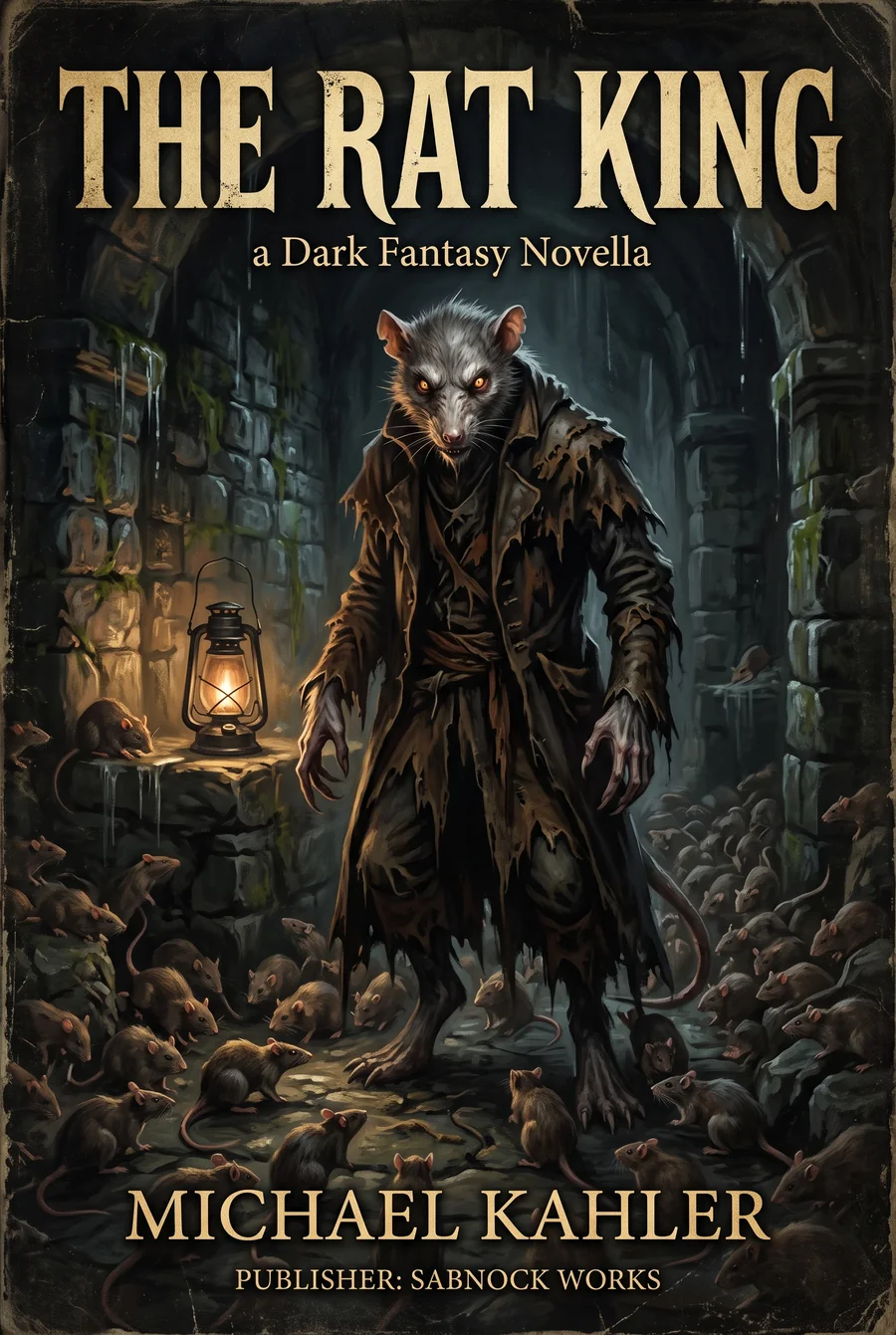
Set down by an unknown hand. The ink is brown. Whether it is rust or blood, the reader must decide.
Chapter I — The Good Work
The rats had been there longer than the family.
Aldric knew it the moment he crossed the low threshold of the Venner household. The smell told him—sour and layered, buried beneath straw, beneath smoke, beneath the thin, vegetal reek of boiled turnips and poverty. Beneath all of it lingered something older: wet fur, rotting incisors, the press of a thousand small lives gnawing patiently within the walls. He had encountered it countless times. It no longer stirred him.
“They come at night,” the woman said. She might have been thirty. Hard years had pushed her well beyond it. A child clung to her skirts, staring at Aldric’s tools—the smoked-glass lantern, the worn leather satchel, the iron tongs blackened at the tips. “They get into the grain. Half our winter stores are gone already.”
“How many children?” Aldric asked. Not for necessity, but calibration.
“Four.”
He inclined his head and set the lantern down. Its light traced the baseboards, revealing long, narrow grooves—incisor work, weeks old, perhaps months. A deep nest, then. Beneath the floor, most likely, or in the hollow behind the east wall where last winter’s freeze had split the daub.
He was correct.
The afternoon passed in steady labor. Two apprentices worked beside him—Tomlin, sixteen and restless with eagerness, and Sefra, quiet, with hands steadier than most journeymen he had known. Three floorboards came up. Beneath them lay the first gallery at knee depth. A second, deeper still, branched outward—a network of packed earth, shredded cloth, and the fine grey dust of devoured grain.
“There,” Sefra murmured, lowering her lantern.
The nest sprawled before them. Forty bodies, perhaps fifty—pink, blind, writhing in the sudden intrusion of light. The mother rose to meet them: a scarred grey matriarch, one eye gone from some earlier war. She balanced on her haunches and screamed—a thin, furious note, sovereign in its fury.
For a fleeting instant, Aldric felt something close to respect.
It passed.
“Seal the eastern gallery,” he told Tomlin. “Tight. I want them driven one way.” His gaze shifted. “Sefra—oil.”
They would flood the galleries and burn them. Not elegant work. Effective work. The Guildmaster had always been clear: a half-dead nest is merely deferred labor. Aldric had never forgotten.
By sunset, the work stood ready—sealed, soaked, awaiting flame.
He crouched at the opening and looked down into the unseen spaces beneath the city he had served for eleven years. Oil stung the air. From below came faint movement—scrambling, frantic, not yet understanding.
He had done this a hundred times.
The tinderbox lay ready in his hand.
Chapter II — What Came Through the Door
The door at the far end of the room should have opened onto the alley.
It did not.
Tomlin noticed first. He had gone for water and did not return. Minutes later, Sefra followed. When she came back, she came alone. Her face had lost all color.
“That’s not the alley,” she said.
Aldric did not reply. He crossed the room and looked.
No alley. No cooper’s yard. No pale autumn sky over Lathmar.
Instead: a corridor. Rough stone. Damp. Narrow. Sloping downward into a darkness that consumed the eye.
Something echoed from far below. Perhaps water. Perhaps not.
He shut the door.
Opened it again.
The corridor remained.
“Close the windows,” he said. His voice held steady—absurdly, almost impressively so. Later, he would remember that steadiness with a brief and pointless pride.
The windows were barred. A chest dragged against the door. The woman gathered her children and whispered prayers to a saint that did not answer.
Then the rats came.
Not from the nest below—that one burned now, smoke rising through the cracks with the bitter scent of scorched fur.
These came from elsewhere.
From impossible directions. From gaps too narrow to admit them. From the air itself.
They were larger. Their eyes caught the lantern-light and held it—too long, too cold, a dull orange gleam that did not belong to any animal. They did not scurry.
They advanced.
Aldric met them.
Iron, fire, precision. Sefra fought beside him. For a time, the room held. He crushed skulls, broke spines, swept bodies into flame with the practiced rhythm of his trade.
But the numbers did not diminish.
Sefra fell. He did not see how. One moment she stood; the next she did not. The children screamed. The mother screamed. Blood slicked Aldric’s hands and forearms and face—shallow wounds, none mortal, though they burned with a coldness that had nothing to do with blood.
He reached the wall.
Pressed against it.
Clarity came then, sharp and absolute:
I have burned a hundred nests. I have never lost.
The rats closed in.
And waited.
Chapter III — The Prince Below
They did not kill him.
That, more than anything, would trouble him later—lying in darkness, feeling their bodies pressed against him, hearing their breath, yet untouched. The thing that wore them had chosen otherwise.
The voice came without direction.
It entered him as cold enters a room—not through a point, but by presence.
I know your name, Aldric.
Silence answered it.
I know them all. Every catcher. Every man who has set fire beneath my children. There have been many. There will be more. And yet…
The rats parted.
Something moved among them—too large for the space, too deliberate. It lingered at the edge of the lantern-light, refusing full form. Claws scraped stone. A vast head suggested itself, ancient, patient.
And yet I am curious about you. You are… competent. Devoted. There is something almost priestly in what you do.
“What are you?” Aldric asked. The first word fractured. The second held.
Names are poor containers, the voice said. But once, in older books, I was called the seventeenth spirit. Prince and Earl. Botis.
A pause.
Names matter less than what is offered.
Cold seeped deeper.
You will not die tonight. Not of these wounds. But you will die here—in darkness, in cold, or in hunger. You will be remembered as the man who lost.
Aldric said nothing.
The city is changing. Doors no longer lead where they should. Depths open beneath depths. I am merely the first consequence. Others will follow. Corruption will rise through the stone like water through roots.
“Why tell me?”
Because you may be useful.
The cold tightened around him.
I offer survival. Knowledge. Dominion. My children know every passage, every truth and falsehood of these shifting doors. With me, you would know them also.
An alliance.
He thought of Tomlin. Of Sefra. Of eleven years of clean, sanctioned work.
A half-dead nest…
I will burn you out, he thought. Every trace of you.
The cold did not acknowledge the thought.
It entered him anyway—through wounds, through doubt, through the thin fractures in certainty.
Aldric did not vanish.
He receded.
Something else stepped forward.
Chapter IV — The Hunt
They found him in the Tanners’ Quarter, three months after the Flattening.
That was the name the city had settled on. The day maps failed. The day doors betrayed expectation. Three months of vanishings, wrong turns, stairways descending where none should be.
Seven exterminators lost.
Pellard led the team. Forty years old, thickset, unhurried. He had known Aldric.
He did not dwell on it.
Eight of them moved through the Quarter, lanterns shuttered. Rats withdrew before them—yet differently now. Disorganized when He was absent. Structured when He drew near.
They were structuring now.
Pellard felt it in the silence.
“Here,” Davan whispered.
The cellar grate yawned open.
The smell struck first—tallow, musk, and beneath it something wrong. Human once. No longer.
They descended.
The space below defied proportion—larger than it should have been. No longer remarkable. Nothing aligned anymore. Walls riddled with tunnels, patterns almost deliberate. Script-like.
At the center—
A figure.
Man-shaped. Almost.
Aldric’s height. His frame. But wrong. The joints miscounted. The proportions subtly inverted. The face—recognizable only in the way distorted reflections are recognizable.
Amber eyes regarded Pellard.
“Aldric.”
The head tilted.
“Come home.”
A sound followed—laughter, perhaps, or something that had studied laughter.
Then the room moved.
They burned it.
The cellar. The shop above. Three adjoining structures. Oil and flame, methodical, sanctioned.
At dawn, Pellard stood among the ruins.
A body lay before him.
Human, in outline. Barely.
He stood over it a long time.
Two men lost. One crippled. Davan staring into nothing.
We won, Pellard thought, without conviction.
He spoke the words required.
Whether Aldric heard them—
He would never know.
Epilogue — The Sovereign
Far beneath the Copper District, in a gallery no hunter had reached, something slept.
A great rat, fed well, tended by many.
It stirred.
Something within it pulled.
The pressure had been there since the burning. Persistent. Knocking from beneath thought itself.
Tonight, it grew stronger.
The body convulsed.
Bones lengthened. Spine twisted. The sound was neither quick nor dignified. Attendants scattered, then returned as understanding settled.
The shape changed.
Rat.
Not rat.
Something between.
Then—
A figure standing in the dark, wearing humanity like a garment ill-fitted and over-altered.
Amber eyes opened.
It called.
Not with sound alone, but with something deeper—through stone, through fur, through bone.
The answer came.
From every wall. Every ceiling. Every hidden space.
Ten thousand small lives, answering.
It had burned before.
It would burn again.
That was not the point.
Cities burn. Men burn. Buildings fall.
Darkness remains.
The Rat King moved.
From the Library of Lathmar — Classification: Uncertain. To be filed under H for History, or W for Warning, at the reader’s discretion.