Introduction
On 7 September 1853, Heinrich Barth entered Timbuktu after more than three years on the road.
By then, James Richardson and Adolf Overweg, the other European members of the original expedition, were dead. Barth was frequently ill, short of money and far beyond regular contact with Europe. His presence in Timbuktu soon became politically dangerous. Some authorities wanted him expelled or surrendered to the ruler of Massina, whose government regarded the Christian traveller and his British connections with suspicion.
Barth survived because Ahmad al-Baqqai al-Kunti, one of the most respected Islamic scholars and political figures of the region, accepted him as a guest and placed him under his protection. Al-Baqqai did more than provide shelter. He argued for Barth’s safety, introduced him to learned circles and discussed religion, politics and history with him. The German traveller remained in Timbuktu and its surroundings until April 1854. During those months, he studied written and oral sources concerning the histories of Timbuktu, Songhay and the Niger region. Heinrich Barth Bibliothek
This episode explains much of what makes Barth worth reading today. He was a European scholar of the nineteenth century and carried many of his century’s assumptions with him. He travelled under British sponsorship as part of a mission concerned with diplomacy, commerce, scientific research and opposition to the trans-Saharan slave trade. His writing sometimes employed hierarchical ideas of cultural development that modern readers will reject.
Yet Barth also worked in ways that were unusual among European travellers of his generation. He learned languages, questioned rulers and merchants, consulted Muslim scholars, collected oral histories and treated African political traditions as evidence. He wanted to know how a city was governed, where its food came from, what its inhabitants produced and how they remembered their past.
Over five and a half years, Barth travelled along routes totalling roughly 20,000 kilometres. He crossed the Sahara, visited the Hausa cities and the Bornu Empire, travelled through the lands around Lake Chad and the Benue River, reached Sokoto and followed the Niger towards Timbuktu. His notes later became a five-volume work of around 3,500 pages, one of the richest European records of North and West Africa in the decades before colonial partition. Deutsche Biographie
The value of that work does not lie in the idea that Barth “discovered” societies that were unknown to their inhabitants. The blank areas on European maps reflected European ignorance. The roads, wells, markets, states and historical traditions were already there. Barth’s achievement was to document some of that existing knowledge with an unusual degree of care.
01 Before the Great Journey
Hamburg, family and education
Heinrich Barth was born in Hamburg on 16 February 1821. His father, Johann Christoph Heinrich Barth, was a merchant. His mother was Hanna Carolina Charlotte Elisabeth Barth, née Zadow. Heinrich grew up with four siblings: Henriette, Theodor, Mathilde and Ludwig.
The family belonged to Hamburg’s educated commercial middle class. This background did not predetermine Heinrich’s career, but the city exposed him to a world shaped by shipping, overseas trade and international correspondence. Products, people and news arrived in Hamburg from distant regions. Geography was part of ordinary commercial life rather than an abstract collection of names.
Barth attended the Gelehrtenschule des Johanneums, one of the city’s oldest academic schools. He developed an early interest in languages and history, the two fields that later set his work apart from the more narrowly geographical accounts of many contemporary travellers. Heinrich Barth Bibliothek
In 1839, at the age of eighteen, Barth moved to Berlin and enrolled at the Friedrich Wilhelm University. He studied classical antiquity, philology, history and geography. Two scholars had a lasting influence on him.
August Boeckh, one of the leading classical philologists of the period, approached the ancient world through inscriptions, institutions, public finance and economic life as well as through literature. Carl Ritter, meanwhile, was helping to establish geography as a modern academic discipline. Ritter studied the relationship between landscapes, societies and historical change.
These influences appeared in Barth’s doctoral dissertation, completed in 1844. Its subject was the commerce and trading history of ancient Corinth. Long before his travels in Africa, Barth was already interested in the connections between cities, routes, markets and political power. Deutsche Biographie
The Mediterranean apprenticeship
During his studies, Barth travelled through Italy in 1840 and 1841. He visited Venice, Florence, Rome, Naples and Sicily, developing a particular interest in the ancient Greek colonies and the wider Mediterranean world.
His next journey was far more ambitious. Between 1845 and 1847, Barth travelled through Morocco, Algeria, Tunisia, Malta, Tripolitania, Cyrenaica and Egypt. He continued through Palestine and Syria, crossed Cyprus and Asia Minor, visited Constantinople and returned to Berlin through Greece.
The journey gave him practical experience that later proved indispensable. He learned how travel depended on local guides, political permission, reliable animals and access to water. He improved his Arabic and became familiar with the social conventions governing hospitality, religious observance and negotiation in Muslim societies. He also learned that European diplomatic protection became weaker with every mile travelled away from the coast. Deutsche Biographie
Barth approached the Mediterranean as a connected historical region. He examined classical ruins, but he did not regard North Africa as an empty landscape surrounding them. Ancient roads, modern caravan routes and inhabited towns belonged to the same geography. The world of Greece and Rome could not be separated from Phoenician, Berber, Arab, Ottoman and Islamic history.
After returning to Berlin late in 1847, Barth completed his habilitation in 1848 and began lecturing at the university. The first volume of his Mediterranean research appeared in 1849 under the title Wanderungen durch die Küstenländer des Mittelmeeres.
A conventional academic career appeared to be taking shape. Then Carl Ritter informed him of a British expedition preparing to leave for the interior of Africa.
The British mission
James Richardson, a British traveller and abolitionist, had persuaded the British government to support a mission from Tripoli towards the Bornu Empire near Lake Chad. Its official objectives combined diplomacy, trade and scientific exploration. Richardson also hoped to negotiate agreements that might weaken the trans-Saharan slave trade by encouraging commerce in other goods.
The expedition needed trained scientists. Christian Karl Josias von Bunsen, the Prussian ambassador in London, helped arrange the participation of two German scholars. Barth would contribute geographical, historical and linguistic research. Adolf Overweg, a younger astronomer and geologist, would concentrate on natural science and surveying. Ritter and the cartographer August Petermann supported their appointment.
Barth’s father strongly opposed the plan. His concern was justified. Travellers entering the central Sahara faced disease, dehydration, robbery, political conflict and the possibility of disappearing without trace. Barth briefly withdrew, but the British government had already accepted his participation. He eventually joined Richardson and Overweg. Project Gutenberg
Barth was twenty-eight years old when he left Berlin in November 1849. He expected a difficult journey, although neither he nor the expedition’s organisers anticipated that it would last almost six years.
Selected sources and further reading
- Christoph Marx, Von Berlin nach Timbuktu: Der Afrikaforscher Heinrich Barth. Biographie (2021). The most substantial recent German biography, based partly on Barth’s surviving correspondence. Wallstein Verlag
- The Heinrich Barth correspondence project at the University of Duisburg-Essen. Particularly useful for Barth’s family, teachers, colleagues and later African companions. Heinrich Barth Bibliothek
- “Barth, Heinrich” in Deutsche Biographie. A detailed chronology of his education, travels, publications and academic career. Deutsche Biographie
- Heinrich Barth, Wanderungen durch die Küstenländer des Mittelmeeres (1849). The principal publication from his travels before the British expedition.
02 Across the Sahara, the Sahel and West Africa
Tripoli and the road south
Barth and Overweg reached Tripoli in January 1850. The following weeks were devoted to preparation. Animals had to be purchased, loads distributed, gifts selected for rulers and supplies calculated for long stretches without reliable markets. The expedition carried surveying equipment, medicines, weapons, books, trade goods and a small boat intended for use on Lake Chad.
This was never an expedition of three Europeans travelling by themselves. Its progress depended on interpreters, servants, animal handlers, guides, merchants and political intermediaries. Information about the condition of a well or a dispute between local groups could determine whether a caravan moved on, waited several weeks or abandoned a road entirely.
The expedition left Tripoli on 31 March 1850 and travelled south through the interior of Ottoman Tripolitania. Its first major destination was Murzuk, the principal town of Fezzan. Murzuk served as one of the great junctions of the trans-Saharan caravan system. Roads led north towards the Mediterranean, west towards Ghat and the Tuareg territories, and south towards Aïr, Bornu and the Hausa lands. Deutsche Biographie
From Murzuk, the expedition continued towards Ghat. Beyond the town lay a geography that European maps represented only imperfectly. The people who crossed it understood the desert through wells, pasture, landmarks, seasonal changes and agreements with the communities controlling particular routes.
Barth began to record this political geography alongside his measurements. A route could be open to one caravan and closed to another. A well might be physically accessible but unusable without permission. Travel depended on relationships as much as on direction and distance.
During this phase, Barth also examined rock engravings in the Sahara. He tried to connect them with changes in environment and human settlement. Some of his interpretations were speculative, but he understood that the desert contained evidence of much older landscapes and societies.
Aïr and Agadez
The expedition crossed into the Aïr Mountains in present-day Niger and established a temporary base at Tintellust. From there, Barth travelled to Agadez.
Agadez had once been among the principal commercial and political centres of the central Sahara. It connected the Mediterranean and Fezzan with Aïr, the salt-producing regions of the desert, the Hausa cities and Bornu. Barth studied its markets, architecture and political traditions, paying particular attention to the relationship between the city and the surrounding Tuareg groups.
His observations challenged the common European image of the Sahara as a vast gap between North Africa and the lands farther south. The desert restricted movement, but it also channelled it. Salt, textiles, livestock, manuscripts and political news travelled along established roads.
Merchants and pastoral communities maintained connections that did not appear on European maps. Deutsche Biographie
A traditional house associated with Barth’s stay later became one of the main places where his journey is remembered. Descendants of the family connected with his local host continued to live there, and part of the building was eventually converted into a small museum.
Katsina, Kano and the death of Richardson
On 11 January 1851, after reaching Damergu, the three European travellers separated to examine different routes. They planned to meet again at Kukawa, the capital of Bornu.
Richardson travelled east. Overweg took a route through areas including Gobir and Maradi. Barth turned towards the Hausa lands and passed through Katsina and Kano.
Kano made a strong impression on him. It was a large manufacturing and commercial city whose textile production reached markets far beyond the region. Cotton cloth, dyed fabrics, leather goods, grain, livestock and imported commodities passed through its markets. Merchants linked Kano with Bornu, Sokoto, the Niger valley and the trans-Saharan routes to North Africa.
Barth tried to understand how this economy worked. He asked about production, prices, political offices and the city’s history. Such passages make his account far more useful than a simple itinerary. Kano appears as an urban society with its own industries and regional influence rather than as a stop on a European traveller’s road. Project Gutenberg
James Richardson never reached Kukawa. He died on 4 March 1851 after months of illness and exhaustion. Barth recovered his papers and continued eastwards. He and Overweg finally met again in Kukawa on 5 May.
Richardson’s death changed the character of the expedition. The British government subsequently authorised Barth to continue its work and manage its remaining resources. What had begun as a mission under Richardson’s leadership increasingly became Barth’s research journey.
Bornu and Lake Chad
Kukawa stood near the western shore of Lake Chad and served as the political centre of the Bornu Empire. Bornu had a long state tradition extending back through the history of Kanem-Bornu. Its rulers governed provinces, collected tribute, maintained armies and negotiated with neighbouring states, desert communities and long-distance merchants.
Barth developed a working relationship with Shehu Umar, the ruler of Bornu, whose permission and protection allowed the expedition to operate from Kukawa. European instructions issued in London could not secure passage through Bornu. That depended on African political authority. Heinrich Barth Bibliothek
Kukawa became a base for journeys in several directions. Overweg took the expedition’s boat onto Lake Chad and visited some of its islands. Barth travelled south towards the Benue River and Adamawa, east towards Bagirmi and north into Kanem.
The movements of the expedition rarely followed a clean line. Barth returned to Kukawa repeatedly, gathered new information, replenished supplies and negotiated permission for another journey. His final route was a network of branches extending from a few temporary bases.
The Benue and Adamawa
In June 1851, Barth reached the Benue River and continued to Yola, the political centre of Adamawa. The landscape differed sharply from the desert and semi-arid regions through which he had previously travelled. Seasonal rain, rivers, cultivated land and more densely settled areas created new logistical conditions.
Adamawa was also undergoing political transformation. Fulani-led expansion had produced an emirate connected with the Sokoto Caliphate, while many communities resisted incorporation, tribute demands and slave raiding. Barth recorded the region’s political organisation, agriculture and settlement patterns alongside his geographical observations.
His journey helped European geographers understand the Benue as part of the wider Niger river system. Yet the information did not come from instruments alone. Local travellers, merchants, officials and residents already knew where the river led. Barth’s contribution was to compare their knowledge with his own measurements and make it accessible to European scholarship. Deutsche Biographie
Kanem, Musgu and Bagirmi
During the following year, Barth and Overweg travelled through the regions surrounding Lake Chad. Their routes took them into Kanem, Mandara, the country then called Musgu in European sources, and Bagirmi.
These territories were affected by conflict among Bornu, Bagirmi, Wadai and numerous regional communities. Warfare and slave raiding shaped politics and trade. The British mission had announced opposition to the slave trade as one of its purposes, but Barth could not observe that system from a position of complete independence. At times he depended on rulers or military forces whose power rested partly on warfare and the capture of enslaved people.
He condemned much of the violence he witnessed and described the destruction caused by raids. His account also reveals the compromises required to continue travelling. This tension should remain visible. Barth’s journey was embedded in the political world he documented, and he could not move through it as a neutral outsider. Project Gutenberg
Adolf Overweg died near Lake Chad on 27 September 1852 after a severe fever. He was thirty years old.
Richardson had died eighteen months earlier. Barth was now the last surviving European member of the expedition.
The people who kept the expedition moving
Describing Barth as travelling “alone” after Overweg’s death conceals most of the expedition.
Mohammed el-Gatroni, a man from Fezzan, remained one of Barth’s closest and most reliable companions for almost the entire journey. He managed practical tasks, dealt with people along the route and helped the expedition function under difficult conditions.
Abbega and Dorugu had previously been enslaved and were freed by Overweg. They later travelled with Barth and eventually accompanied him to Europe, where their linguistic knowledge contributed to his studies. Dorugu later taught Hausa. Abbega worked as an interpreter and went on to hold an important position at Lokoja.
Other participants appear only briefly in the written record: guides who knew the wells, messengers carrying letters between courts, servants caring for animals, interpreters and local hosts. Their knowledge made the journey possible even when the published books placed Barth’s name on the title page. Heinrich Barth Bibliothek
The expedition’s archive was therefore produced through many conversations. Barth deserves credit for recording information with unusual care, but he did not create that knowledge by himself.
Sokoto and the road to the Niger
After Overweg’s death, Barth decided to continue westwards rather than return immediately to the Mediterranean.
He travelled through Zinder, Katsina and Wurno before reaching Sokoto, one of the principal centres of the Sokoto Caliphate. He spoke with rulers, officials and scholars, gathered political traditions and continued through Gando towards Say on the Niger.
From the Niger, Barth crossed regions associated with Gurma and Liptako and moved through parts of what are now Niger, Burkina Faso and Mali. The journey became increasingly precarious. He had limited funds and unreliable supplies, while his safety depended on letters of introduction and the willingness of one authority to recommend him to the next.
The road to Timbuktu could not be forced by determination alone. Every stage required negotiation with people who controlled access, transport or information.
Barth reached Kabara, Timbuktu’s river port, on 5 September 1853. Two days later, he entered the city. Deutsche Biographie
Seven months in Timbuktu
European readers had turned Timbuktu into a symbol long before Barth arrived. Earlier accounts portrayed it as a city of gold, an inaccessible centre of trade or a forbidden place at the edge of the known world.
The city Barth encountered was neither a fantasy nor a relic. Its commercial position had changed since the height of the Mali and Songhay empires, but it remained connected to Saharan trade, Islamic scholarship and the politics of the Niger bend. Its inhabitants lived amid conflicts involving Tuareg groups, the rulers of Massina, regional scholars and commercial interests.
Barth’s Christian identity became known. Ahmadu III, the ruler of Massina, demanded his expulsion or surrender. Ahmad al-Baqqai refused.
Al-Baqqai belonged to the Kunta scholarly tradition and possessed religious as well as political authority. His protection was not a minor act of hospitality. By defending Barth, he took a position in a regional dispute and placed his own standing behind the safety of a Christian guest. Heinrich Barth Bibliothek
Barth spent much of his stay under restrictions intended to keep him safe. The enforced delay gave him time to speak with al-Baqqai and other scholars. He collected accounts of the Mali and Songhay empires, examined genealogies and compared oral traditions with Arabic writings. He also recorded information about Timbuktu’s neighbourhoods, mosques, markets and political divisions.
He did not discover that West Africa had a history. West African scholars and communities already preserved that history in manuscripts, institutions, family traditions and collective memory. Barth recognised these materials as sources that European historians ought to take seriously.
His relationship with al-Baqqai continued after he left. Their discussions had included theology and politics, and neither man surrendered his convictions. The importance of the encounter lies in the fact that they met as educated adults capable of sustained disagreement, rather than as a European investigator and an anonymous “native informant.”
Barth left Timbuktu on 19 April 1854.
The long return
The return journey followed the Niger eastwards through the region of Gao and then back through Say, Sokoto, Wurno and Kano.
Barth’s health deteriorated repeatedly. Funds and supplies ran low, while communication with Europe had broken down for so long that some observers assumed he was dead. On 1 December 1854, between Kano and Kukawa, he unexpectedly met Eduard Vogel, a German astronomer whom the British government had sent to reinforce the expedition and find out what had happened to him.
After returning to Kukawa, Barth prepared for the journey north. He left on 10 May 1855 and travelled through the desert oasis of Bilma, then continued to Murzuk and Tripoli. He reached Tripoli on 28 August and crossed the Mediterranean shortly afterwards, arriving in Europe in September 1855. Deutsche Biographie
Barth returned with notebooks, route measurements, sketches, maps, historical accounts and extensive linguistic material. Later biographical literature credits him with recording words or information from forty-nine African languages and language varieties. This should not be confused with speaking forty-nine languages fluently. His practical knowledge was strongest in Arabic and several major languages used along his route, including Hausa and Kanuri, while other vocabularies were gathered through speakers and interpreters. Deutsche Biographie
His published observations ranged from rainfall and river systems to market prices, court offices, crops, textiles, architecture, medicine and religious life. That breadth remains the central strength of his work.
It also reveals its limits. Barth misunderstood some of what he heard, relied on translations and sometimes accepted rumours. He applied European categories to societies that did not organise themselves according to them. His books must be compared with Arabic manuscripts, oral histories, archaeology and other contemporary accounts.
A useful source does not need to be infallible. It needs to preserve enough evidence to be questioned.
Selected sources and further reading
- Heinrich Barth, Travels and Discoveries in North and Central Africa in the Years 1849 to 1855, five volumes, 1857–1858. The essential primary source. The Project Gutenberg text currently available online is based on a later abridged English edition and does not replace the original volumes. Project Gutenberg
- A. H. M. Kirk-Greene, ed., Barth’s Travels in Nigeria (1962). A focused edition of Barth’s material on Katsina, Kano, Bornu, Adamawa, Sokoto and neighbouring regions. nigeriareposit.nln.gov.ng
- Steve Kemper, A Labyrinth of Kingdoms: 10,000 Miles Through Islamic Africa (2012). A readable modern narrative of the expedition.
- Mamadou Diawara, Paulo Fernando de Moraes Farias and Gerd Spittler, eds., Heinrich Barth et l’Afrique (2006). A collection of African and European scholarship on Barth’s methods, sources and interpretations. Köppe Verlag
- The University of Duisburg-Essen’s biographical records. Especially useful for Mohammed el-Gatroni, Abbega, Dorugu, Shehu Umar and Ahmad al-Baqqai. Heinrich Barth Bibliothek
03 Return to Europe: Fame, Publication and an Uneven Academic Career
International recognition
Barth returned to Europe with a considerable reputation. Reports of his survival and the scale of his journey attracted attention well beyond Germany.
The geographical societies of London and Paris awarded him major gold medals. Oxford and Jena granted him honorary doctorates. The Berlin Academy of Sciences had elected him a corresponding member on 11 August 1855, shortly before his return. Germany therefore did not ignore him, although the most conspicuous honours immediately following the expedition came from international institutions. Deutsche Biographie
In November 1855, Barth settled in London and began turning his field notes into a full account. This was an enormous undertaking. The German and English editions of Reisen und Entdeckungen in Nord- und Central-Afrika and Travels and Discoveries in North and Central Africa appeared between 1857 and 1858.
Together, the five volumes comprised roughly 3,500 pages. They contained maps, illustrations, itineraries, linguistic notes, political histories, descriptions of trade and long discussions of individual towns and regions. Dutch, Danish and French translations followed. Deutsche Biographie
The work secured Barth’s scholarly reputation, but its form made a broad popular afterlife less likely. It was dense, argumentative and filled with material that resisted reduction to a simple adventure. Readers encountered dynastic succession, textile production, river courses, grammatical observations and disputed place names alongside stories of danger.
Barth rarely placed himself at the centre for long. His books devoted more attention to the countries through which he travelled than to the cultivation of his own legend.
Berlin and the unfinished work
Barth returned permanently to Berlin in 1859. He became active in the Berlin Geographical Society, first as its second chairman and from 1863 as its first chairman. He also helped establish a foundation honouring Carl Ritter and encouraged further research on Africa.
In 1863, he received a professorial appointment and began teaching geography at the University of Berlin. The position came late. Barth had only two years in which to build a more settled academic career before his death. Deutsche Biographie
He continued working on African languages. His Sammlung und Bearbeitung central-afrikanischer Vokabularien was intended as a broad comparative study, drawing partly on information gathered during the expedition and on the knowledge of African speakers who had travelled to Europe. The project remained incomplete.
Barth also resumed travelling. In 1858 he crossed northern Asia Minor from Trabzon towards the Bosporus. Later journeys took him to Spain, the Balkans, the Alps, Italy, Macedonia, Albania and Montenegro. These trips reflected the Mediterranean interests that had shaped his career before Africa.
Heinrich Barth died in Berlin on 25 November 1865 after a brief illness. He was forty-four years old. Deutsche Biographie
Honoured abroad, forgotten at home?
The familiar claim that Barth was celebrated everywhere except Germany is too simple.
German institutions recognised him. Jena awarded him an honorary doctorate, the Berlin Academy elected him and the Geographical Society placed him in a leading position. He taught at Berlin’s university and remained part of German scholarly life.
The contrast concerns the durability and character of his reputation. British institutions had financed the expedition, and the Royal Geographical Society celebrated its results. French geographers also honoured him. In Germany, Barth never developed the public profile later associated with travellers such as David Livingstone or Henry Morton Stanley.
Several factors probably contributed. Barth died young and left no long professorial career or group of students to maintain his reputation. His principal work was too large for casual reading. He had no missionary organisation, newspaper empire or colonial publicity campaign turning his life into a national story.
His strongest claim to attention was also difficult to dramatise. He had produced an archive.
Among specialists, that archive remained important. Historians of the Sahara, the Hausa states, Bornu, Sokoto and the Niger region continued to use it. In 1962, A. H. M. Kirk-Greene published Barth’s Travels in Nigeria, extracting and organising the sections most relevant to Nigerian history. Ghanaian historian A. Adu Boahen reviewed the edition in The Journal of African History. Barth’s work was being read as evidence for African history rather than merely as a European tale of exploration. nigeriareposit.nln.gov.ng
Barth was therefore never completely forgotten. His name gradually withdrew into specialist scholarship while the information he collected continued to circulate.
Selected sources and further reading
- Christoph Marx, Von Berlin nach Timbuktu (2021). Particularly useful for Barth’s correspondence, academic ambitions and relationship with German institutions. Wallstein Verlag
- The Humboldt University scientific collections biography. A concise chronology of Barth’s later career and professorship. Sammlungen
- “Barth, Heinrich” in Deutsche Biographie. The main source for his honours, publications, later travels and offices. Deutsche Biographie
- A. H. M. Kirk-Greene, ed., Barth’s Travels in Nigeria (1962), and A. Adu Boahen’s contemporary review. Useful evidence of Barth’s place in twentieth-century African historiography. nigeriareposit.nln.gov.ng
04 Heinrich Barth Seen from the Present
A source from the decades before colonial partition
Barth travelled before the large-scale European conquest and partition of Africa during the late nineteenth century. The societies he described were already connected to North Africa, Europe and the Ottoman world, and they were far from peaceful or static. Wars, political expansion, enslavement and economic inequality formed part of the history he recorded.
Even so, his journey took place before colonial governments imposed new borders, legal systems and economic structures across most of the continent. His books therefore preserve information about states and communities during a period that later conquest transformed profoundly.
Researchers still use Barth for the study of political history, trade, agriculture, urban life, languages and historical geography. His descriptions are especially valuable where local archives were later dispersed or destroyed. Wallstein Verlag
The material requires critical handling. Barth selected what interested him. He depended on translators and informants whose words passed through his notes and categories. He sometimes misunderstood local political relationships or tried to reconcile traditions that did not fit neatly together.
Modern scholars can compare his account with manuscripts, oral traditions, archaeological evidence and regional scholarship. The detail in his work makes such criticism possible. A thin account can only be accepted or rejected. Barth left enough material for later historians to test his conclusions.
Restoring the other participants
Modern readings of the expedition also pay more attention to the people who made Barth’s work possible.
Ahmad al-Baqqai should not appear merely as the local protector who saved a European explorer. He was a scholar and political actor with his own understanding of Islam, European expansion and the affairs of the Niger region. His decision to protect Barth reflected religious principles and regional politics.
Mohammed el-Gatroni contributed years of labour and practical knowledge. Abbega and Dorugu brought linguistic expertise and personal histories shaped by enslavement and emancipation. Shehu Umar’s political support made research from Kukawa possible. Numerous unnamed guides, merchants and officials supplied information that Barth could not have obtained from European sources. Heinrich Barth Bibliothek
Recognising these contributions does not diminish Barth’s achievement. It describes more accurately how his knowledge was produced.
He listened, compared accounts and preserved an unusual amount of what he heard. The resulting books bear his name, but their contents emerged from encounters across many languages and social worlds.
Agadez and Timbuktu
Barth’s memory has acquired a physical presence in some of the places along his route.
In Agadez, the traditional mud-brick house associated with his stay survived under the care of the family connected with his local host and guide. Part of it became a small museum. A rehabilitation project carried out in 2009 involved local craftspeople and a Nigerien conservator, with support intended to preserve the building and make it useful for local education and cultural exchange. The project documentation also records a historical plaque at the site. Jutta Vogel Stiftung
In Timbuktu, the house in which Ahmad al-Baqqai lodged Barth became another memorial. In 2000, ten information panels and a trilingual brochure were prepared for the Heinrich Barth House with support from the German Foreign Office. A visitor’s account from 2012 documented a plaque, a small exhibition room and the street name Rue Heinrich Barth. Heinrich Barth Institut
The current condition and accessibility of these places cannot be assumed, especially after years of conflict and insecurity in Mali. The available evidence nevertheless confirms that Barth has been commemorated through houses, exhibitions, plaques and a street name.
A public statue of Heinrich Barth in Mali, Niger or Nigeria is sometimes mentioned in general accounts. I found no dependable heritage, museum, governmental or scholarly source confirming such a statue. It may be possible that a local monument has escaped online documentation, but the claim should not be presented as fact without evidence.
The verified memorials are more revealing than a statue would be. They mark places where Barth depended on African hosts and entered existing social worlds. They preserve the setting of an encounter rather than isolating the European traveller on a pedestal.
Is Barth better known in Africa than in Germany?
There is no reliable survey comparing public awareness of Barth in Germany with awareness in Mali, Niger, Nigeria or other African countries. Africa cannot be treated as a single audience, and specialist recognition should not be confused with general popularity.
A narrower claim can be supported.
In Niger, a house in Agadez preserves his memory. In Mali, his Timbuktu residence became a memorial site, and a conference commemorating his arrival brought together Malian and international scholars. The resulting volume, Heinrich Barth et l’Afrique, includes critical as well as appreciative readings of his work. In Nigeria, substantial portions of his journals were republished specifically as sources for the country’s history. Jutta Vogel Stiftung
These examples show that Barth has a meaningful place in particular African scholarly and heritage contexts. In Germany, he remains familiar to historians of geography and Africa but is largely absent from general public memory.
He has not vanished completely. The Heinrich Barth Institute in Cologne bears his name and conducts research on African archaeology, environmental history and rock art. A large modern biography appeared in 2021, and the digital correspondence project at the University of Duisburg-Essen has made extensive material on Barth and his network available to researchers. Heinrich Barth Institut
Barth may therefore be more visible at several places along his former route than he is in everyday German historical culture. That statement is more precise than claiming that he is generally “famous in Africa.”
A useful but difficult legacy
Barth has sometimes been presented as a modern anti-colonial thinker born a century too early. That interpretation removes too much of his historical context.
He believed in European science and progress. He supported expanded commercial relationships and participated in a state-sponsored British mission. Some of his language reflects nineteenth-century hierarchies of civilisation. He could be impatient, judgmental and convinced of the superiority of particular European institutions.
Reducing him to an agent of later colonialism would be equally misleading. Barth travelled decades before formal partition and showed little enthusiasm for conquest. He repeatedly recognised African rulers as legitimate political actors and African scholars as intellectual counterparts. His reconstruction of African histories challenged the belief that the continent lacked institutions, historical memory or written traditions before European intervention.
What sets him apart is the effort he made to understand societies through their own languages, sources and political circumstances. He did not always succeed, but the attempt shaped his entire body of work.
Selected sources and further reading
- Mamadou Diawara, Paulo Fernando de Moraes Farias and Gerd Spittler, eds., Heinrich Barth et l’Afrique (2006). The most useful collection for modern Africanist and critical perspectives on Barth. Köppe Verlag
- The Jutta Vogel Foundation’s documentation of the Heinrich Barth House in Agadez. The principal source for the 2009 rehabilitation project. Jutta Vogel Stiftung
- Clara Himmelheber, Heinrich Barth: Zehn Seiten eines Afrikaforschers / Ten Sides of an Explorer’s Life (2000). The trilingual brochure associated with the information panels in the Timbuktu house. Heinrich Barth Institut
- The Heinrich Barth Institute’s account of the Timbuktu memorial project. Useful for the house, information panels and Barth’s relationship with Ahmad al-Baqqai. Heinrich Barth Institut
- Christoph Marx, Von Berlin nach Timbuktu (2021). The most recent comprehensive reassessment of Barth’s life and intellectual setting. Wallstein Verlag
05 Why Heinrich Barth Became the Historical Foundation of Routes of Africa
Routes of Africa begins with a European map that is incomplete. The world beyond its known lines, however, is already organised.
Caravans follow roads shaped by generations of experience. Wells belong to communities or fall under the authority of particular rulers. Guides know which valleys remain passable and which routes have become dangerous. Cities trade with distant regions, scholars preserve histories and political decisions made hundreds of kilometres away can close a road overnight.
Heinrich Barth offers an unusually suitable historical perspective for a game built around that kind of exploration.
We did not choose him as a flawless hero. His assumptions, his British sponsors and his place within nineteenth-century European scholarship remain part of the story. What interests us is his method. Barth tried to learn how the societies he visited worked before reducing them to familiar European categories. He paid attention to languages, markets, political offices, religious authority and local accounts of the past.
That approach gives Routes of Africa a different foundation from the conventional game about exploration and expansion.
A journey through inhabited history
The player will not command an army or annex cities. The current design follows an expedition whose success depends on preparation, information and relationships.
The opening stages begin on the Mediterranean coast. Tunis and the ruins of Carthage introduce the historical connections between Europe, North Africa and the wider Mediterranean. The route then continues towards Tripoli. Murzuk becomes the first great threshold, the place where the expedition must prepare for travel beyond the coast and enter the trans-Saharan caravan system.
Water, food and animal feed determine how far the caravan can travel. Tents, money, pack animals and suitable companions affect its ability to survive. A well-equipped expedition can still fail through poor information, damaged relationships or a route chosen at the wrong time of year.
The map will reveal itself gradually. The player selects destinations without seeing a neat grid of reliable roads. An old account may contain errors. A valley may end at an unexpected rock face. A route described as short may lack water. Turning back can consume supplies that were calculated for the outward journey.
Careful surveying takes time, but it produces a more accurate route. Hurrying saves provisions and may be necessary under political or seasonal pressure, although the resulting map will remain uncertain. A well-measured road can make a later return faster and safer.
These systems are not decorations placed around the journey. They are the journey.
Knowledge comes from people
Barth’s expedition also helps us move away from the familiar image of the solitary explorer.
A guide should not function as a passive bonus attached to the player character. He may know the wells, speak with local authorities and maintain relationships that the expedition cannot replace. An interpreter decides how a conversation crosses languages. A merchant may understand political changes long before they appear in official reports.
Companions also have their own concerns. They may refuse a route, object to a decision or have obligations to people encountered along the way. Trust cannot be reduced to a supply stored in a wagon, although it can be gained and lost through the player’s actions.
The historical Barth survived because people such as Mohammed el-Gatroni, Shehu Umar and Ahmad al-Baqqai chose to help him. That assistance was never automatic. It emerged from employment, diplomacy, hospitality, religious principles, political calculation and personal respect.
Routes of Africa should reflect that complexity. The expedition’s knowledge grows through relationships rather than through the simple removal of fog from a map.
Discovery without ownership
Many strategy games treat geographical knowledge as a form of possession. Once the player reveals a region, the game marks it as controlled, exploited or available for settlement.
Our aim is different. Recording a lake does not transfer ownership of it. Mapping a caravan road does not mean that the player created the road. Visiting a city does not give the player authority over its inhabitants.
Successful exploration can produce reputation, publications and further funding. Better maps can support later journeys. Reports may interest universities, geographical societies or sponsors. None of this changes the fact that the places being described have their own authorities and histories.
Barth’s work provides a useful historical model because his best observations continually point beyond the traveller. Kano mattered because of its industries and trade. Agadez mattered because of its political and commercial position. Timbuktu mattered because of its scholars, manuscripts and memory. Their significance did not begin when a European arrived.
Conflict without caricature
A respectful historical approach does not require romanticising the nineteenth-century Sahara and Sahel.
The game’s world includes enslavement, raids, warfare, political coercion and religious conflict. Barth witnessed societies under pressure and sometimes relied on rulers involved in violence. Those elements must be represented without turning every African authority into either a villain or an enlightened helper waiting for the player.
European motives also require scrutiny. The British expedition combined scientific research and opposition to the slave trade with commercial and diplomatic ambitions. Those objectives could reinforce one another, but they could also conflict. Later European states would use geographical knowledge for purposes far removed from Barth’s scholarly interests.
The player should encounter these tensions rather than receive a simple moral verdict. Decisions may produce benefits for one group and costs for another. Accurate knowledge can improve travel while also becoming valuable to governments and commercial interests.
Barth is useful here because his own position was complicated. He neither fits the role of innocent observer nor that of colonial conqueror. His work records the possibilities and compromises of an era in which scholarly exploration, diplomacy and expanding European influence were already intertwined.
The expedition as a gameplay structure
Barth’s journey contains the basic rhythm around which Routes of Africa is being designed.
An expedition begins with a plan based on incomplete information. The player chooses companions and equipment, calculates supplies and secures financial or political support. Once the caravan leaves, weather, illness, local conflict and unexpected geography begin to undermine the original plan.
Progress produces observations. Those observations improve maps and reports. A successful return brings reputation and new funding, allowing a later expedition to travel farther or revisit a region with better preparation.
Failure remains possible. Richardson and Overweg both died. Barth repeatedly suffered serious illness and ran out of money. His survival depended on decisions made by people outside the expedition. The history contains no guarantee that effort will be rewarded.
This uncertainty matters more than reproducing Barth’s exact itinerary. Routes of Africa is not intended as a sequence of predetermined historical checkpoints. The player should understand why the route to a destination changed, why waiting could be safer than moving and why another person’s knowledge might matter more than a European instrument.
Why Barth
We chose Heinrich Barth because he provides a historical path into Africa that does not begin with conquest.
He entered societies with his own assumptions and sometimes judged them according to European standards. At the same time, he made a sustained effort to learn their languages, examine their institutions and preserve their accounts of the past. His books contain errors and prejudices, but they also contain thousands of pages devoted to the agency and history of the people he met.
That is the principle we want to carry into the game.
The player begins with an incomplete map. Progress comes from learning how the roads, cities and political relationships already function.
Selected sources and further reading
- Heinrich Barth, Travels and Discoveries in North and Central Africa. The primary source for the routes, logistical problems, political negotiations and encounters underlying the game’s historical concept. Project Gutenberg
- Christoph Marx, Von Berlin nach Timbuktu (2021). A modern interpretation of Barth’s motives, methods and relationship with African societies. Wallstein Verlag
- Mamadou Diawara, Paulo Fernando de Moraes Farias and Gerd Spittler, eds., Heinrich Barth et l’Afrique. Important for moving beyond the older European heroic narrative. Köppe Verlag
- The University of Duisburg-Essen’s documentation of Barth’s companions, hosts and protectors. A basis for representing expeditions as networks of people rather than the achievement of a single traveller. Heinrich Barth Bibliothek
- Sabnock Works, current internal design concept for Routes of Africa. Source for the planned expedition systems, gradual cartography, resource management and opening route through Tunis, Tripoli and Murzuk.
What Heinrich Barth Left Behind
Barth returned to Europe with maps, vocabularies, route measurements and years of written observations. The material he collected documented manufacturing cities, regional states, Islamic scholarship, commercial networks and political histories that remained poorly understood in Europe.
His account does not give Europe ownership of those histories. It records an encounter between a European scholar and people who already knew their countries, remembered their past and maintained the roads on which he travelled.
Barth’s books are still worth reading because they preserve part of that encounter in unusual detail. They also show how dependent an explorer was on the knowledge, authority and protection of others.
That is the historical starting point for Routes of Africa: an incomplete European map and a continent already crossed by roads.
About this edition
Copyright © 2026 Sabnock Works. All rights reserved. This web edition reproduces the text of the September 2026 PDF edition, with its illustrations and source notes where present. Historical material is presented for educational and creative discussion; comparisons with game design and the world of Lathmar are interpretive.
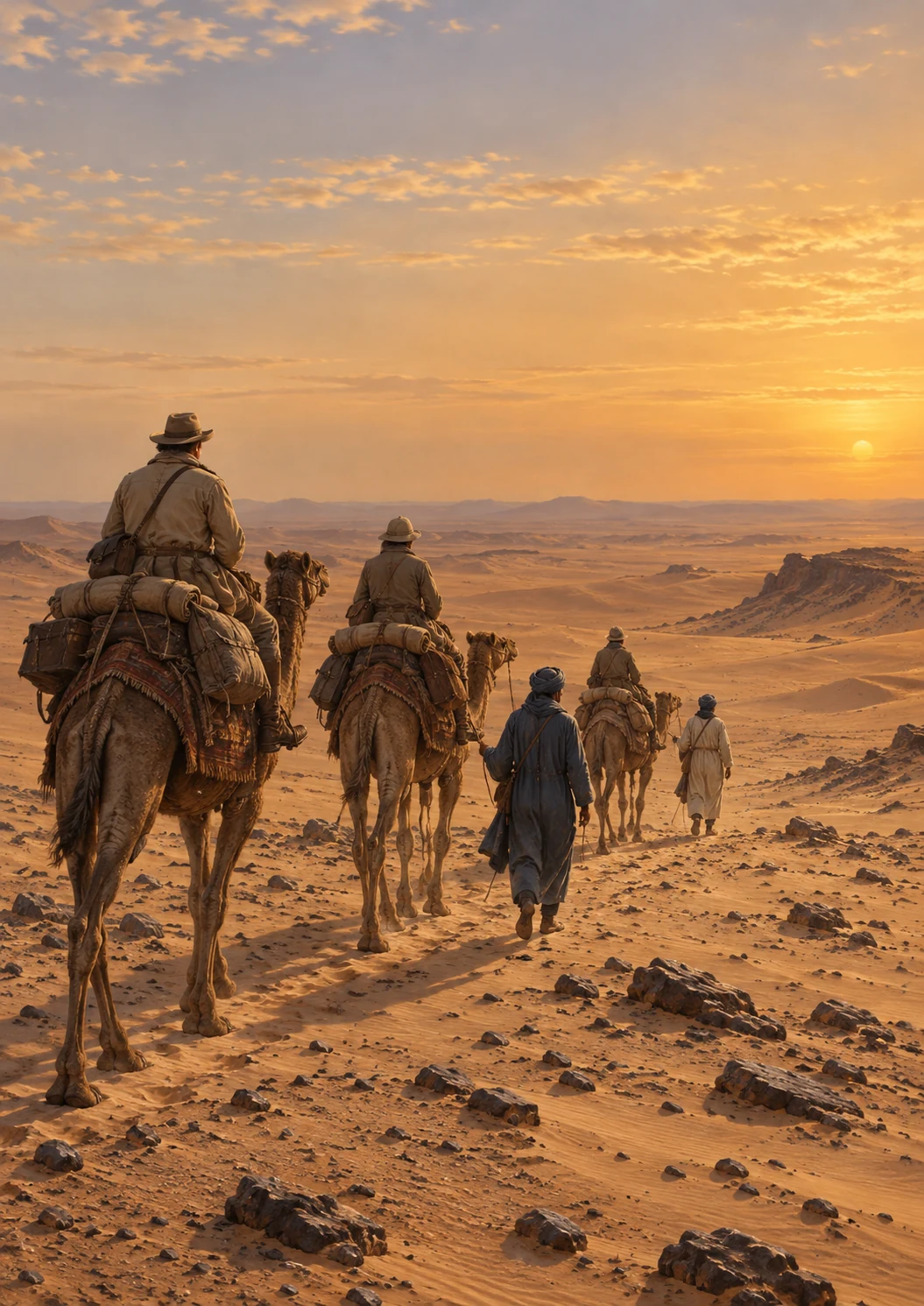
Cover illustration created for the PDF edition with OpenAI image generation under the direction of Sabnock Works.
Download the original PDF edition · Return to the essay archive